
29 Jan Spindle
Spindle (Euonymus europaeus)
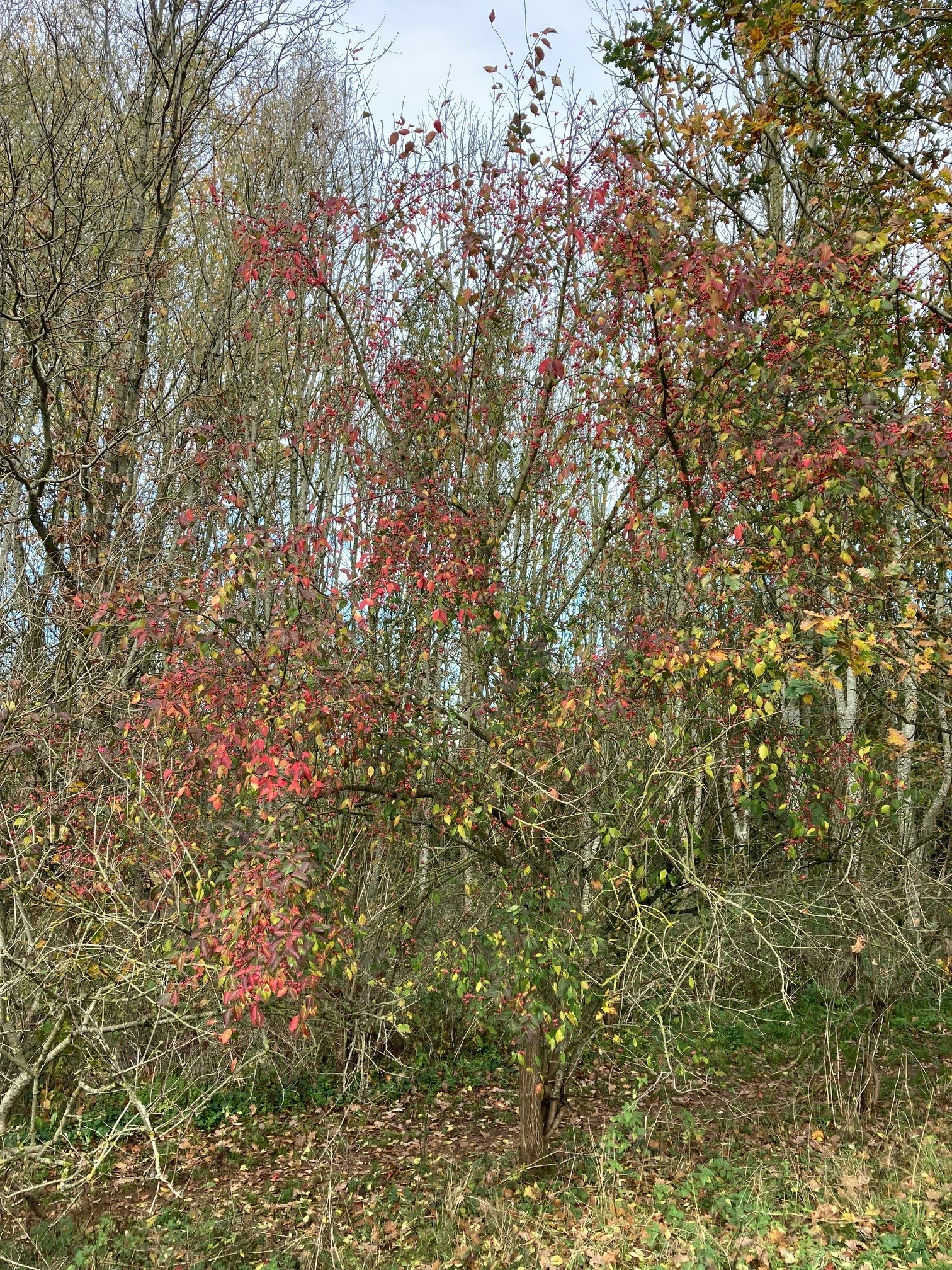
The spindle tree (Euonymus europaeus) is a small deciduous tree or large shrub native to much of Europe. Though modest in size compared to forest giants, its fiery autumn colours, delicate flowers, and brightly coloured fruit brings beauty to hedgerows and woodland margins throughout the year. Wildlife loves its leaves and fruit, and aphids flock to it, bringing with them an array of predators including hoverflies, ladybirds and lacewings.
The wood of spindle is exceptionally fine-grained, pale, and hard. Historically, it was used to make spindles for spinning wool, giving the tree its common name. It was also used for pegs, skewers, toothpicks and knitting needles, and these days it is favoured for artist’s charcoal.
The spindle’s botanical name, Euonymus, is from the Greek ‘eu’, meaning ‘good’ and ‘onoma’, meaning ‘name’. This is said to have meant ‘lucky’. In European folklore it became symbolically linked with protection, fate, and transformation because of its use in making spinning tools. This association echoes wider European myths, including tales of the Fates and fairy stories such as Sleeping Beauty, where a spindle plays a pivotal role.
Despite its protective symbolism, almost every part of the spindle is toxic to humans if ingested, therefore its popularity today lies in its ornamental value.
Appearance and Identification
Spindle typically grows to 3-6 metres tall, forming a rounded, often multi-stemmed shape. Its bark is smooth and grey when young, becoming slightly fissured with age. The twigs are slender and green, often showing subtle corky ridges that help distinguish the plant from similar shrubs.

Spindle bark
The leaves are opposite, oval, and finely toothed, measuring 3-8cm in length. During spring and summer they are a soft mid-green, but in autumn they transform into vivid shades of crimson, scarlet, and purple, making spindle one of the most colourful native hedgerow trees. The leaves are eaten by caterpillars of moths, including the magpie, spindle ermine and scorched, as well as the holly blue butterfly.

Spindle leaves

Caterpillars nesting in Spindle
In late spring, small greenish-white flowers appear in loose clusters. While individually inconspicuous, they attract pollinating insects. By autumn, these flowers develop into the plant’s most distinctive feature: bright pink or red four-lobed capsules that split open to reveal vivid orange seeds. These fruits are highly decorative but toxic to humans.

Spindle fruits
Propagation and Control
Spindle thrives in woodland edges, hedgerows, scrubland, and chalky hillsides. It prefers well-drained soils, particularly those rich in lime, and grows best in full sun to partial shade.
Although tolerant of a range of conditions, spindle does not favour waterlogged soils. It is often found as part of mixed native hedges, where it provides seasonal interest and valuable habitat for wildlife. Birds are particularly fond of the fruit, helping to disperse the seeds.
Source and Reference Materials
Information detailed in this post has been obtained from the author’s own knowledge and photographic library where possible. Additional source of information and photographs include:
Van den Berk, B.V. (2004). Van den Berk on Trees. Van den Berk Nurseries